
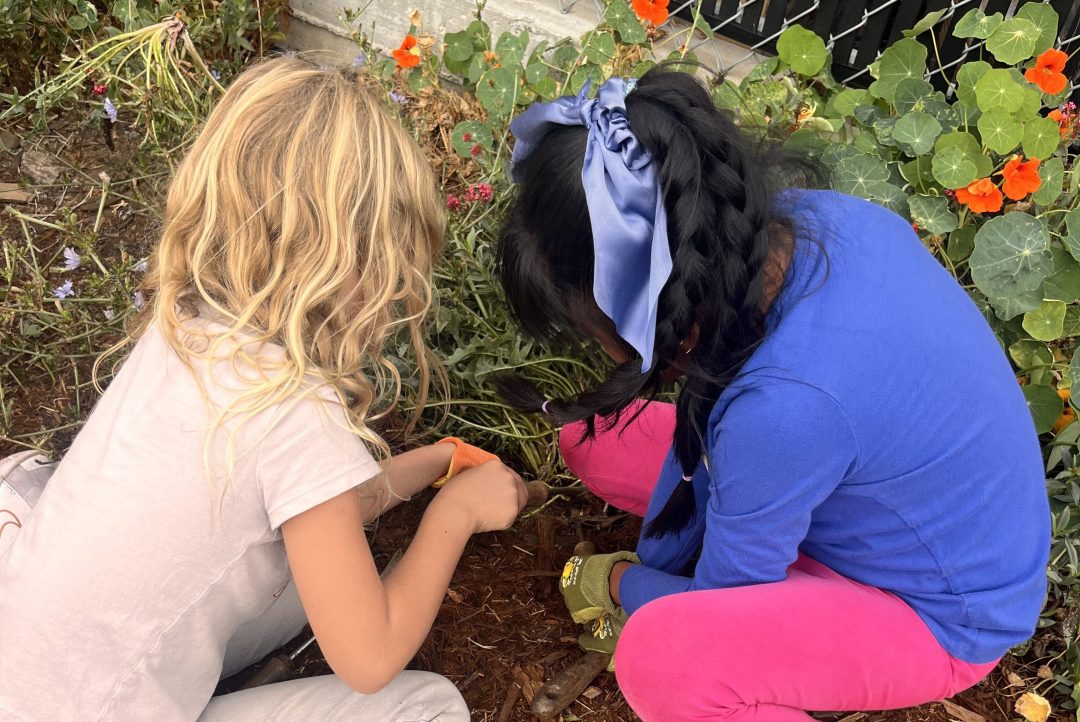
On a hot Tuesday afternoon in mid-September, Lea Ortiz and I welcomed thirteen eager participants to the fall season of Dirt Girls at Willow Magnet School. Lea is a TK teacher, an inaugural Erin Soper Awardee, and one of Willow’s school garden champions.
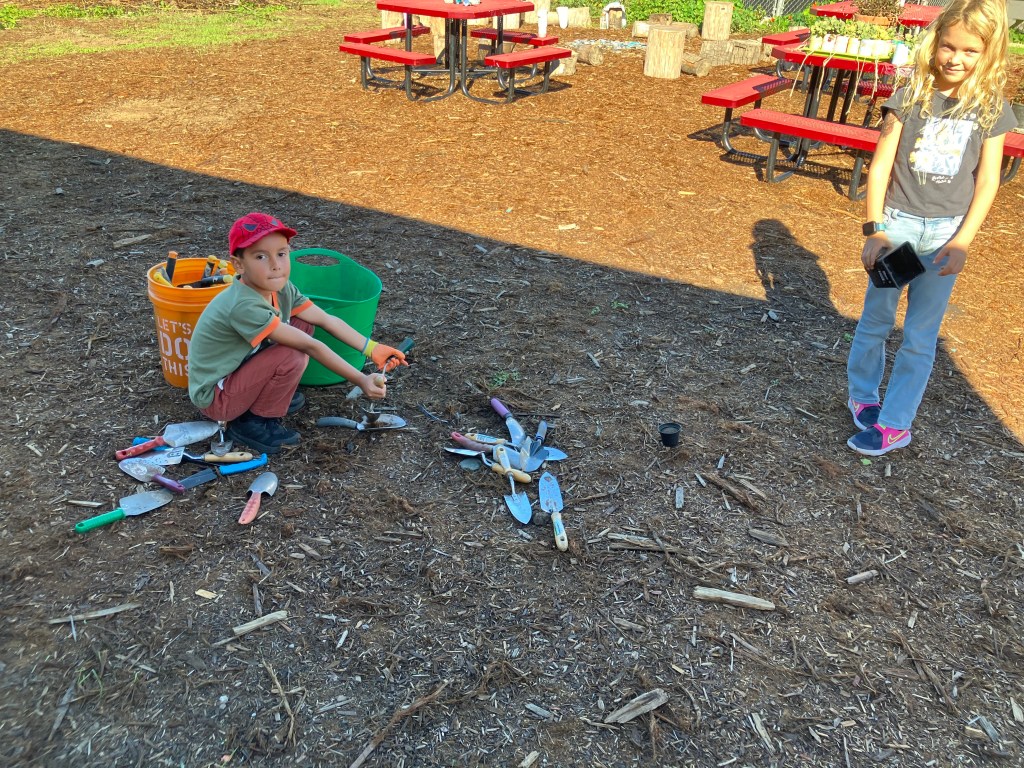
Although the fall equinox was behind us, it was still a sunny 94°F. We moved slowly to huddle in the shadiest spot we could find: a corner of the garden in the long shadow of the toolshed. After our opening circle of introductions and team-building exercises, we talked about garden tools.
We named all the tools we could think of, which was a fair number given the gardening experience in this group. About half of our participants said they had a garden at home, a feature that supports apprenticeship learning. Kids who have more gardening experience become peer leaders.
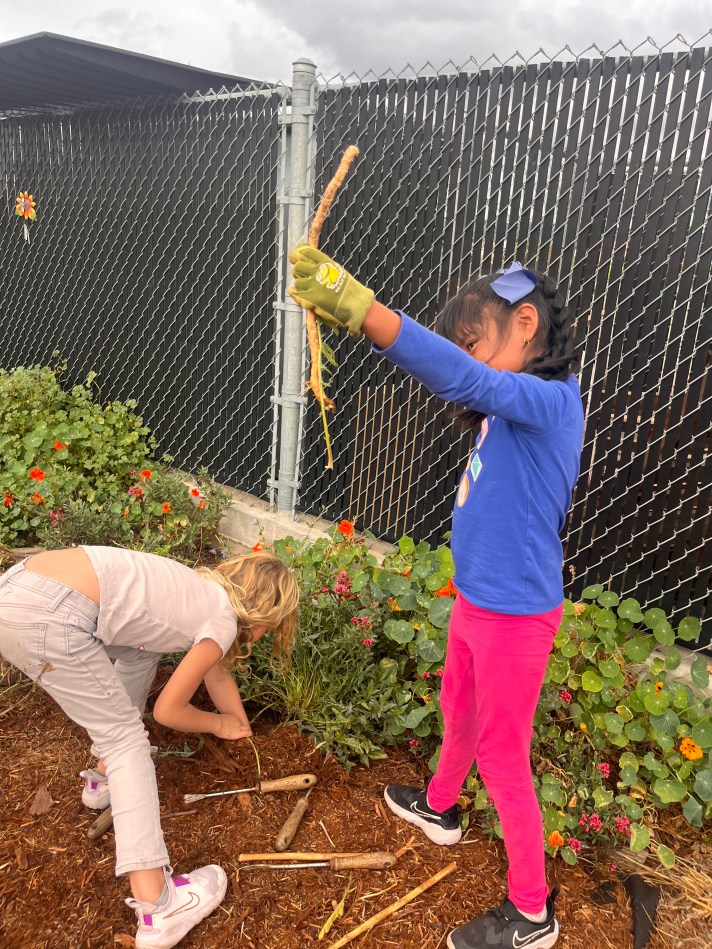
We then considered our hands as one of our most basic, yet most essential tools. We put on gloves (another tool) and used our hands to harvest cherry tomatoes. If you’ve never worked with children in a garden, you may not realize that just getting a pair of garden gloves on small hands is a lesson in itself.
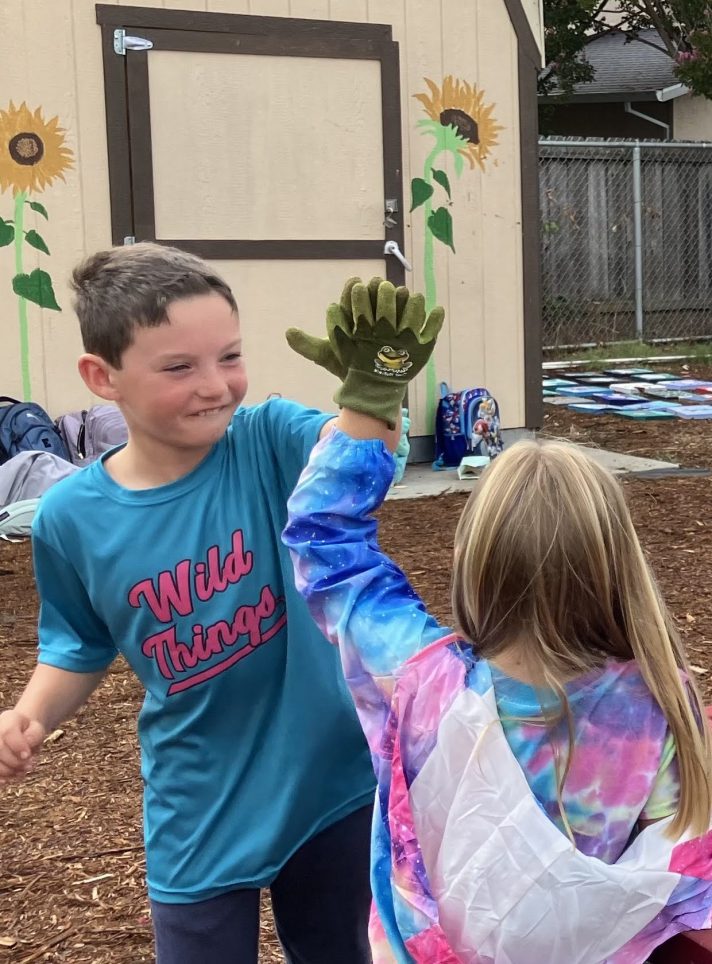
First, we partner kids up using strategies that allow them to meet new kids. After partnering up, we demonstrate how one person holds a glove with the opening facing the partner. The other spreads their five fingers and slides them into the glove. If they accomplish the task for both people, they celebrate with a high five. This fall, we had a sibling pair in the club who were especially enthusiastic high-fivers.
We had two sibling pairs and one set of cousins in our fall crew. It helps families with carpool and care logistics if kids can join the same after school enrichment class. It also helps with social connectedness.
Making new social connections is one of six program outcomes we use to evaluate Dirt Girls. These outcomes are measured at the beginning and end of our ten-week season together: make social connections, develop hobbies and interests, engage in teamwork and projects, perform garden maintenance, benefit from mentorship, and learn science and horticulture.
We use the Mind Pie activity (photo below) to invite participants to share their thoughts about each outcome. Mind Pie is a simple, and effective tool for gathering metrics about our strengths. The activity uses a drawing of a pie with sections–in this case 6, one for each outcome. We pose a series of statements, one at a time. We may also pass around an image that represents that outcome. For example, to measure social connectedness, we show a picture of the opening circle and read, “I met someone I didn’t already know.”
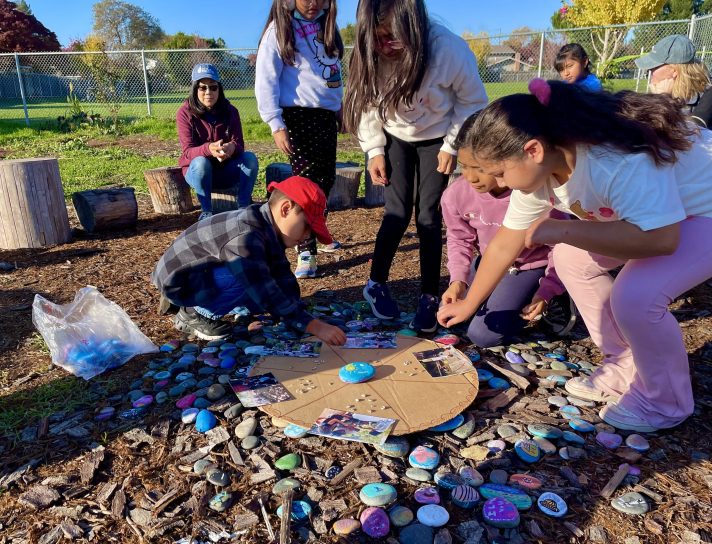
As we read each statement, kids reflect and respond by placing a token in the section of the pie dedicated to that statement. We use seeds as our ‘voting’ pieces. If the statement applies to them, they put a seed on the part of the pie. The six statements are:
- I met someone I didn’t already know.
- I learned a new skill.
- I liked working as a team to complete a project.
- I have a garden at home.
- I learned what a scientist does.
- I would join this club again.
This activity lets us know kids’ preferences and tailor our program to provide new learning opportunities. For example, although most kids liked working in a team, one of the fall participants indicated that she did not like teamwork. “I like working alone,” she said. Because we asked this question at the start of the program, we made sure this participant always had a little time to herself in the garden.
We always expect some team participation and we strive to create high-quality teamwork tasks. We accomplished a lot as a result! In addition to harvesting, weeding, collecting seeds, and planting fall crops, we spent a little time each session learning about the monarch butterfly life cycle. In our final session, each child planted a narrow-leaf milkweed plant, a start to the habitat we will continue to install this spring.
Three of our board members were able to attend our final session of the fall Dirt Girls season. We were all overjoyed to learn that “I would join this club again” garnered a seed from every participant.
As I wrote in Growing Smiles @New Tech High, satisfaction with an out-of-school program is important because these programs fill a much needed enrichment gap for students. Dirt Girls has a clearly articulated purpose, but the benefits of the program go beyond the participants. After school garden clubs also build educators’ capacity to garden-based lessons. They also provide maintenance that otherwise gets inconsistent attention. It’s a win-win-win!
Do you know a school garden that might benefit from the Dirt Girls program model? If so, please share our interest form. We are currently is seeking a site partner for the 2026-27 school year.
Discover more from
Subscribe to get the latest posts sent to your email.

 schoolgardendoctor.org
Your recap here offers insight and guidance, as well as access to resources. Nicely done.
LikeLiked by 1 person